

L-Lysine HCL Market Strengthens from USD 264.5M in 2025 to USD 420.3M by 2036 with Ajinomoto, CJ CheilJedang Corporation
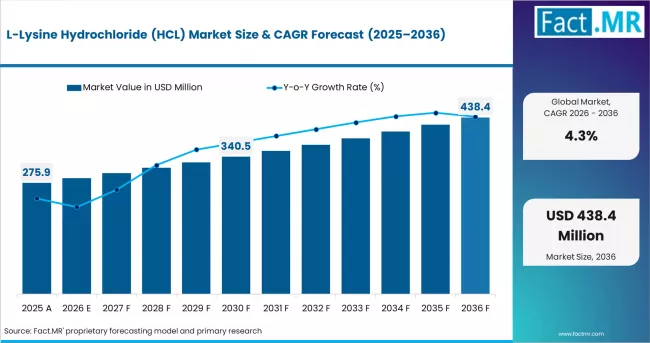
The L-Lysine Hydrochloride (HCL) Market is segmented by Source, Application, and Region. Forecast for 2026 to 2036.
ROCKVILLE, MD, UNITED STATES, April 17, 2026 /EINPresswire.com/ -- The global L-Lysine Hydrochloride (HCL) market is projected to grow from USD 275.9 million in 2026 to USD 420.3 million by 2036, expanding at a CAGR of 4.3%. Growth is driven by rising demand in animal feed, aquaculture nutrition, and pharmaceutical-grade amino acids, despite ongoing pricing pressure from global oversupply.𝗚𝗲𝘁 𝗗𝗲𝘁𝗮𝗶𝗹𝗲𝗱 𝗠𝗮𝗿𝗸𝗲𝘁 𝗙𝗼𝗿𝗲𝗰𝗮𝘀𝘁𝘀, 𝗖𝗼𝗺𝗽𝗲𝘁𝗶𝘁𝗶𝘃𝗲 𝗕𝗲𝗻𝗰𝗵𝗺𝗮𝗿𝗸𝗶𝗻𝗴, 𝗮𝗻𝗱 𝗣𝗿𝗶𝗰𝗶𝗻𝗴 𝗧𝗿𝗲𝗻𝗱𝘀: https://www.factmr.com/connectus/sample?flag=S&rep_id=14730
📊 Quick Stats at a Glance
Market Size (2025): USD 264.55 Million
Estimated (2026): USD 275.9 Million
Forecast (2036): USD 420.3 Million
CAGR (2026–2036): 4.3%
Top Application: Animal Feed (~63% share)
Leading Source: Fermentation-based (corn/molasses) (~66% share)
Top Growth Country: United States (4.8% CAGR)
🧪 Market Overview
The L-Lysine Hydrochloride (HCL) market represents a critical segment within the global amino acids industry, supplying an essential amino acid used in animal nutrition, pharmaceuticals, and functional foods.
Produced primarily through microbial fermentation of corn and molasses, L-Lysine HCL plays a vital role in:
Enhancing protein synthesis in livestock feed
Supporting clinical nutrition and nutraceutical formulations
Improving feed efficiency and sustainability
The market is currently at a strategic inflection point, shifting from commodity-driven growth to value-driven, pharma-grade specialization.
🚀 Key Growth Drivers
Expansion of Livestock & Poultry Production
Rising global demand for meat and dairy products
L-Lysine improves:
Feed conversion efficiency
Protein utilization
Strong growth in Asia-Pacific and Latin America livestock sectors
Aquaculture Feed Demand Surge
Increasing adoption in fish and shrimp feed formulations
Supports fishmeal replacement strategies
Enhances sustainable aquaculture production
Rising Nutraceutical & Pharmaceutical Applications
Growing use in:
Clinical nutrition
Dietary supplements
Strong demand for GMP-certified, high-purity lysine in North America and Europe
Precision Animal Nutrition Trends
Increasing focus on optimized amino acid balance
Reduces nitrogen emissions and improves sustainability
📈 Key Market Trends
Shift Toward Pharma-Grade Lysine
Producers moving away from low-margin feed-grade products
Increasing investment in high-purity, regulated segments
Market Bifurcation
Two distinct segments emerging:
Commodity feed-grade lysine (price-driven)
Pharma/food-grade lysine (quality-driven)
Dominance of Fermentation Technology
Corn and molasses-based fermentation remains industry standard
Offers:
High yield
Cost efficiency
Regulatory acceptance
Sustainability & Alternative Feed Inputs
Growing interest in plant-based fermentation substrates
Focus on reducing environmental footprint
⚙️ Segment Insights
By Application
Animal Feed: ~63% share
Dominates due to its role as the first-limiting amino acid in livestock diets
Emerging segments:
Pharmaceuticals
Functional foods
Beverages
By Source
Fermentation-based (meat/corn/molasses): ~66% share
Preferred for efficiency and scalability
🌍 Regional Insights
Asia Pacific – Global Production Hub
China controls over 60% of global lysine production
Strong supply-side dominance creates:
Price competition
Global export influence
North America – High-Value Market
Growth driven by:
Clinical nutrition demand
Nutraceutical applications
United States: 4.8% CAGR leader
Canada – Aquaculture Growth Center
Demand driven by salmon farming and feed optimization
🏢 Competitive Landscape
The market is moderately concentrated, with clear segmentation between volume-based Chinese producers and premium global suppliers.
Key Players
Ajinomoto Co., Inc.
CJ CheilJedang Corporation
Kyowa Hakko Bio Co., Ltd.
Evonik Industries AG
Meihua Holdings Group
Ningxia Eppen Biotech
Global Bio-Chem Technology Group
Competitive Dynamics
Chinese companies: Dominate low-cost, high-volume supply
Global players: Focus on:
GMP-certified production
Pharmaceutical-grade lysine
Precision nutrition solutions
💡 Expert Insight
Industry experts emphasize a critical strategic shift:
Commodity lysine markets are facing long-term margin pressure
Future growth lies in high-purity, regulated, and application-specific lysine segments
This transformation is redefining supplier positioning across the global value chain.
⚠️ Challenges & Restraints
Global oversupply, especially from China, leading to price pressure
Volatile feedstock costs (corn, molasses)
Competition from alternative amino acids
High cost of pharmaceutical-grade production
📊 Opportunity Outlook
USD 144.4 million incremental opportunity expected through 2036
Expansion in:
Aquaculture nutrition
Functional foods
Clinical and nutraceutical applications
Growth in precision livestock feeding systems
❓ FAQs
What is L-Lysine Hydrochloride used for?
It is used as an essential amino acid supplement in animal feed, pharmaceuticals, and functional foods.
What is driving market growth?
Growth is driven by livestock production, aquaculture expansion, and rising nutraceutical demand.
Which segment dominates the market?
Animal feed dominates with ~63% share, followed by pharmaceutical applications.
Why is the market facing price pressure?
Due to oversupply from large-scale Chinese production, which controls over 60% of global output.
What is the future trend in the market?
The market is shifting toward pharma-grade, high-purity lysine and precision nutrition applications.
📣 Conclusion
The global L-Lysine HCL market is transitioning from a commodity-driven supply model to a quality-focused, value-added ecosystem. While pricing pressures persist, the future lies in pharmaceutical-grade innovation, sustainable feed solutions, and precision nutrition, positioning the market for steady, long-term growth in specialized applications.
𝗨𝗻𝗹𝗼𝗰𝗸 𝟯𝟲𝟬° 𝗜𝗻𝘀𝗶𝗴𝗵𝘁𝘀 𝗳𝗼𝗿 𝗦𝘁𝗿𝗮𝘁𝗲𝗴𝗶𝗰 𝗗𝗲𝗰𝗶𝘀𝗶𝗼𝗻 𝗠𝗮𝗸𝗶𝗻𝗴 𝗮𝗻𝗱 𝗜𝗻𝘃𝗲𝘀𝘁𝗺𝗲𝗻𝘁 𝗣𝗹𝗮𝗻𝗻𝗶𝗻𝗴 : https://www.factmr.com/checkout/14730
Related Reports:
Sodium Diacetate as Mold Inhibitor in Packaged Bread Market: https://www.factmr.com/report/sodium-diacetate-as-mold-inhibitor-in-packaged-bread-market
Pigeon Pea Market: https://www.factmr.com/report/pigeon-pea-market
Sugar Reduction Mouthfeel Recovery Additives Market: https://www.factmr.com/report/sugar-reduction-mouthfeel-recovery-additives-market
Pea Starch for Clean-Label Confectionery Applications Market: https://www.factmr.com/report/pea-starch-for-clean-label-confectionery-applications-market
S. N. Jha
Fact.MR
+1 628-251-1583
email us here
Legal Disclaimer:
EIN Presswire provides this news content "as is" without warranty of any kind. We do not accept any responsibility or liability for the accuracy, content, images, videos, licenses, completeness, legality, or reliability of the information contained in this article. If you have any complaints or copyright issues related to this article, kindly contact the author above.
